Overview
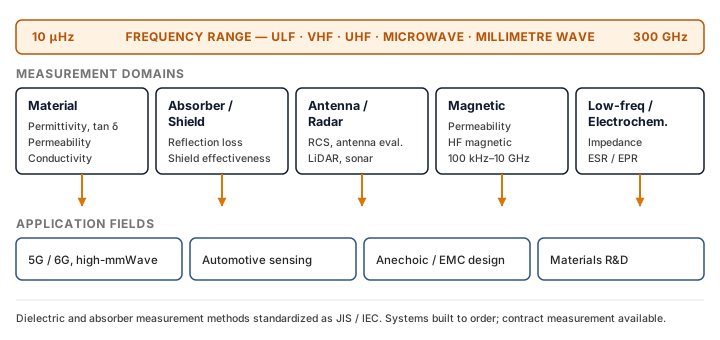
Development, manufacturing, and measurement of high-frequency metrology technology covering the 10 µHz to 300 GHz range — from ultra-low frequencies through VHF, UHF, microwave, millimeter-wave, and sub-millimeter-wave bands. Measurement systems for dielectric constant, permeability, conductivity, shielding effectiveness, and radio-wave absorptance, as well as evaluation systems for antennas, radar, LiDAR, and sonar, are designed, fabricated, and operated in small quantities to order. Compatible with virtually all material forms: solids, sheets, films, powders, liquids, and multilayer structures. Proprietary measurement techniques have been codified as standards for the measurement of dielectric properties in the millimeter-wave band (JIS R 1660-2) and for the measurement of reflectivity of radio-wave absorbers (IEC 62431 / JIS R 1679).
Technical Features
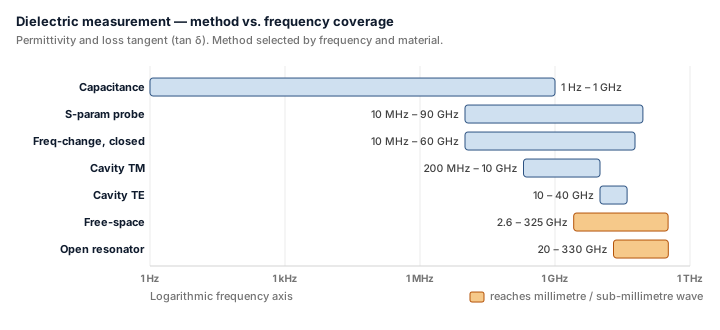
- Permittivity and loss tangent measurement (multiple methods): The optimal technique is selected according to measurement frequency and material type — cavity resonator method (TM-mode: 200 MHz–10 GHz; TE-mode: 10–40 GHz), open resonator method (20–330 GHz; high accuracy for low-loss materials), free-space frequency-variation method (2.6–325 GHz; suitable for thick specimens), S-parameter/probe method (10 MHz–90 GHz; suitable for high-loss materials), and capacitance method (1 Hz–1 GHz). Both relative permittivity and loss tangent (tan δ) are measured.
- Radio-wave absorption and shielding evaluation: Reflectivity measurement of radio-wave absorbers, shielding effectiveness (SE) measurement, and transmission loss measurement, all in conformance with standardized test methods.
- Magnetic property measurement: Permeability measurement systems and high-frequency magnetic measurements (100 kHz–10 GHz).
- Antenna and radar metrology: Radar cross-section (RCS) measurement, antenna evaluation, and millimeter-wave measurements. Automotive applications include bumper (radome) evaluation, LiDAR testing, ADAS evaluation, and ultrasonic sonar testing.
- Low-frequency and electrochemical measurement: Electrochemical impedance measurement (1 mHz–200 kHz), electrical conductivity and insulation resistance measurement, and ESR/EPR (electron spin resonance) measurement systems.
- High-frequency measurement equipment: The laboratory is equipped with a 110 GHz vector network analyzer, a 110 GHz scalar network analyzer, an 80 GHz spectrum analyzer, and a 70 GHz oscilloscope, among other instruments.
- Contract measurement services: In addition to equipment sales, contract measurement of materials and devices is available using in-house instrumentation.
Intended Applications and Fields
- Dielectric characterization of substrates, films, and radio-wave absorbing materials for 5G/6G and high-millimeter-wave wireless applications.
- Sensing performance evaluation of automotive radar, LiDAR, and sonar systems, including transmission characterization of radomes (bumpers).
- Material evaluation for radio-wave absorption and shielding design in anechoic chambers and equipment enclosures.
- High-frequency characterization of magnetic materials and low-loss materials.
- Contract measurement and custom measurement systems for R&D at universities, research institutes, and industry.
Scope of Capabilities
- Measurands: Relative permittivity and loss tangent / permeability / conductivity and insulation resistance / radio-wave absorptance and reflectivity / shielding effectiveness / RCS and antenna parameters / electrochemical impedance
- Material types: Solids, sheets, films, powders, liquids, multilayer structures, and more
- Frequency range: 10 µHz–300 GHz
- Delivery format: Design and fabrication of measurement systems (small volumes and custom orders); contract measurement services
- Standardization: Measurement methods for dielectric properties and radio-wave absorption have been codified in JIS and IEC standards. The company has participated as a member of standards development committees.
Monozukuri Finder can connect you with Japanese manufacturers capable of delivering this technology. Inquiries regarding detailed specifications or overseas implementation are welcome.