Overview
In-house development of wireless remote I/O units and wireless sensors using 920 MHz band specified low-power radio, plus contract design and manufacturing of FA equipment for small and mid-sized production runs. The company handles the full scope in-house: electrical and electronic circuit design, PCB design and fabrication, firmware development, harness design and manufacturing, and component procurement. Involvement begins at the requirements and conceptual design stage, with end-to-end coverage through component selection, PCB, harness and mechanical design, manufacturing and procurement, and assembly inspection. Through a network of mechanical designers, the company can also propose complete system-level solutions.
Technical Features
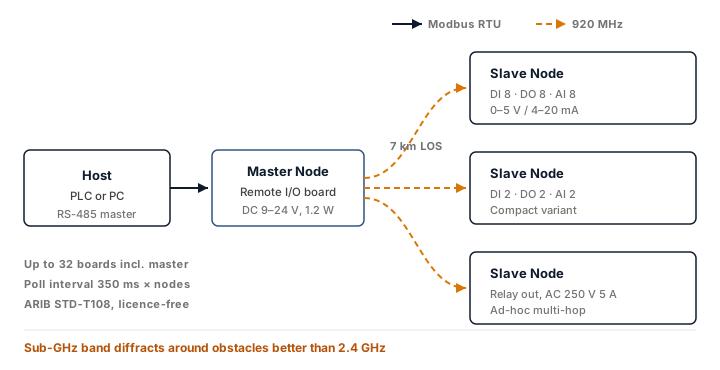
- 920 MHz band specified low-power radio: Compliant with ARIB STD-T108; license-free operation. The PCB-form remote I/O achieves 7 km line-of-sight outdoors; the AC-powered unit form achieves 1 km. The 920 MHz band offers superior diffraction characteristics compared with the 2.4 GHz band.
- Multi-drop connectivity via Modbus RTU: Up to 32 nodes including the master can be connected over RS-485 using Modbus RTU. Communication interval is 350 ms × number of slave nodes. The unit form supports configurations of up to 31 slave nodes.
- Versatile I/O configurations: The 8-point I/O model provides 8 NPN inputs (one of which supports counter mode), 8 transistor outputs (max. DC 30 V, 1 A; convertible to relay output), and 8 analog inputs (4 voltage channels 0–5 V / 4 current channels 4–20 mA; resolution 1.2 mV / 5 μA). The 2-point I/O model is a scaled-down version of the same configuration.
- Ad-hoc multi-hop: The AC-powered unit form supports relay topologies via an ad-hoc multi-hop network. Relay contact outputs enable direct drive of loads up to AC 250 V, 5 A (resistive load).
- Field-installation considerations: Push-in terminal blocks for wiring, and on-board LEDs for monitoring signal strength and communication status. Optional temperature/humidity sensor and a real-time clock with capacitor backup are available.
- End-to-end support and safety standards: One-stop coverage from specification review through to volume production. Designs comply with both domestic and international safety standards.
Intended Applications and Target Industries
- Adding I/O to existing equipment where cable routing is impractical; reducing wiring work through wireless connectivity.
- Signal transmission between remote installations requiring kilometre-range line-of-sight distances outdoors.
- Monitoring equipment operating status and environmental values, including logging configurations with a two-year data retention period.
- Contract design and manufacturing of FA equipment and industrial machinery in small to mid-sized volumes, including complete supply of PCBs and harnesses.
- Prototype and small-lot harness procurement; same-day shipment available for orders using in-stock materials.
Key Specifications
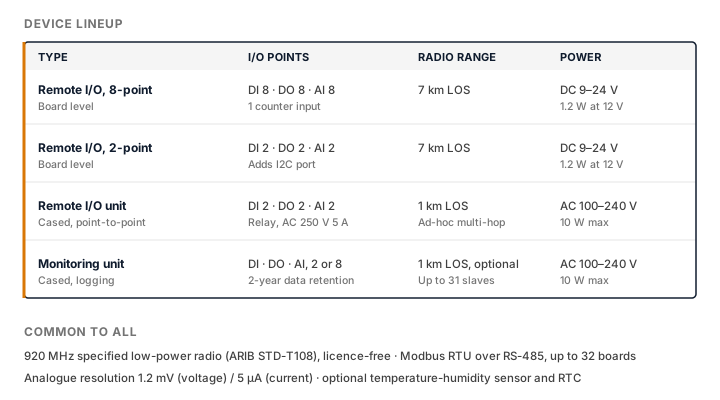
- Radio: 920 MHz specified low-power radio (ARIB STD-T108 compliant) / Communication range: 7 km line-of-sight outdoors (PCB form), 1 km (unit form) / For use within Japan
- Communication: Modbus RTU (RS-485), up to 32 nodes (including master) / RS-485, RS-232C, UART, I2C ports
- Power supply: PCB form — DC 9–24 V ±5%, 1.2 W (at 12 V) / Unit form — AC 100–240 V ±10%, 50/60 Hz, max. 10 W
- Operating temperature: −20 to +70 °C (remote I/O unit), −20 to +55 °C (monitoring unit)
- Harnesses: UL1283 / UL1015 / UL1007 / UL2651 and others, AWG 8–26. Equipment on hand includes semi-automatic crimping machines, wire stripping machines, automatic length-measuring and cutting machines, harness checkers, and crimp height gauges.
Monozukuri Finder can introduce you to Japanese manufacturers with expertise in this technology. Enquiries regarding detailed specifications or overseas implementation are also welcome.