Overview
Design and manufacture of power supplies for semiconductor laser (LD) drivers, along with picosecond pulsed laser light sources built around them. Choose from an LD lineup spanning 375–1550 nm, driven at pulse widths as narrow as 40–80 picoseconds. Available in a bare-board form factor for equipment integration and a cased form factor for research and laboratory use. Supports PC control via USB as well as standalone operation without a USB connection. A high-power nanosecond variant is also offered, using a DFB configuration at 1064 nm with peak power of 400–700 mW.
Technical Features
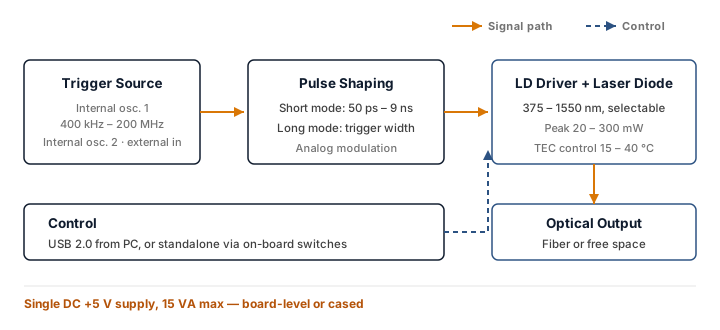
- Wavelength selection and pulse width: Wavelength lineup 375–1550 nm. Minimum pulse width 40–80 ps (determined by the LD used; 200 ps for 472/488/520 nm), maximum pulse width 9 ns. Peak power 20–300 mW.
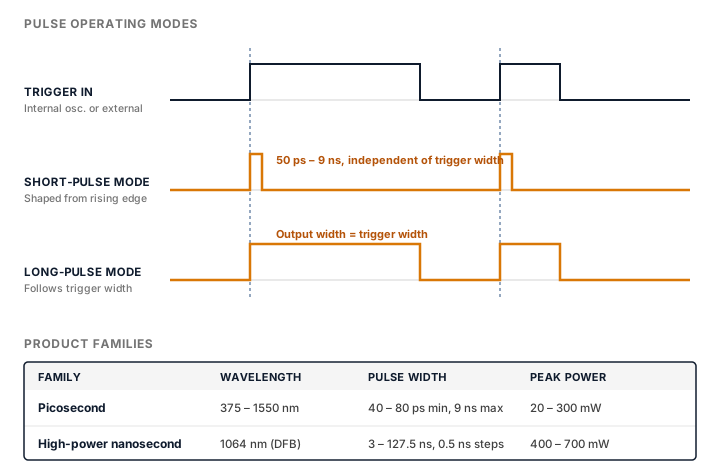
- Two pulse operating modes: Short-pulse mode shapes the waveform to a pulse width of 50 ps–9 ns, triggered from the rising edge of the trigger signal. Long-pulse mode outputs the trigger signal’s pulse width as-is. Certain models support switching between both modes and analog modulation.
- Wide repetition frequency range: Two onboard oscillators cover 400 kHz–200 MHz and 3 kHz–200 kHz respectively. An external oscillator is required for 250 MHz and above.
- Trigger I/O: Trigger output connector SMB (1 V/50 Ω); external trigger input connector SMB (threshold +0.5 V).
- LD temperature control: TEC-based LD temperature control, settable range 15–40 °C (optional 15–60 °C). Storage ambient temperature −10 to +50 °C.
- Control interface: PC control via USB 2.0 Full Speed (control software included). Standalone operation also supported — the LD and TEC can be switched on/off using onboard switches without a USB connection.
- High-power nanosecond model: DFB configuration at 1064 nm; pulse width adjustable from 3 to 127.5 ns in 0.5 ns steps. Peak power 400–700 mW (maximum current 2 A), single-mode fiber FC/APC output. Internal oscillation 1.5 kHz–2 MHz; external trigger up to 10 MHz. Trigger delay settable from 0 to 255 ns in 1 ns steps.
- Output format and form factor: Fiber output board 80 × 100 × 18 mm; free-space output board 80 × 112 × 18 mm (weight 150 g including aluminum base). Cased versions: 95 × 130 × 70 mm / 200 g and 200 × 140 × 70 mm / 800 g. Power supply DC +5 V (3 A, AC adapter); power consumption 15 VA or less.
Intended Applications
- Excitation light source for fluorescence lifetime measurements (FLIM/TCSPC, etc.). Suited to applications requiring picosecond-range pulse widths and a wide repetition frequency range.
- Light source for various optical measurement systems. Select a wavelength from 375–1550 nm and configure the system to suit the measurement target.
- LED light source for distance-measurement devices.
- Equipment integration. The board form factor, single DC 5 V supply, and standalone operation enable installation inside instruments.
- Research and laboratory use. Cased form factor and PC control software support benchtop operation.
Key Specifications
- Picosecond model: Wavelength 375–1550 nm (selectable) / Pulse width 40–80 ps to 9 ns / Peak power 20–300 mW / Internal oscillation 400 kHz–200 MHz and 3 kHz–200 kHz
- High-power nanosecond model: Wavelength 1064 nm (DFB) / Pulse width 3–127.5 ns (0.5 ns steps) / Peak power 400–700 mW / Internal oscillation 1.5 kHz–2 MHz, external trigger up to 10 MHz
- Common: Single DC +5 V supply (AC adapter), power consumption 15 VA or less, USB control and standalone operation, TEC temperature control 15–40 °C
Monozukuri Finder can connect you with Japanese manufacturers capable of delivering this technology. Detailed specifications and inquiries regarding overseas adoption are welcome.