Overview
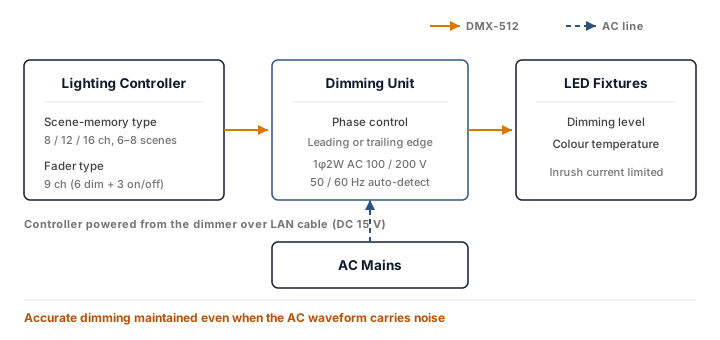
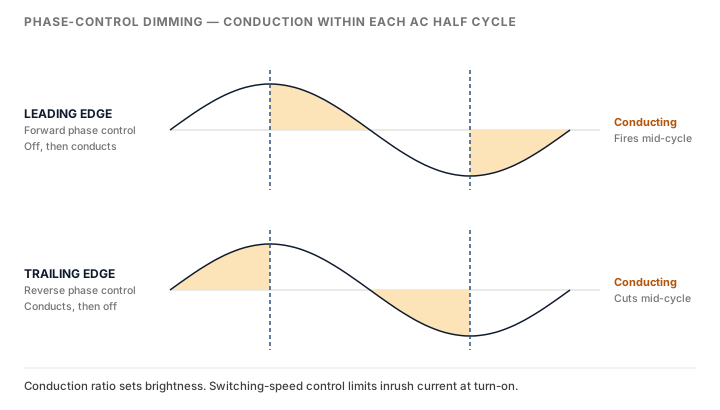
Design and manufacture of dimming units and lighting controllers for LED luminaires. Dimming is achieved via phase control, which varies the on/off time ratio within each half-cycle of the AC waveform; controllers and dimming units communicate over DMX-512. The company’s scope covers the design and manufacture of dimmer panels, lighting control consoles, and specialty lighting fixtures, as well as spatial lighting design for hotels, banquet halls, retail spaces, museums, and amusement facilities, custom control-system design, and on-site commissioning and effects programming. Multiple patents are held for circuit-level solutions to the inherent challenges of phase control.
Technical Features
- Phase-control dimming: Brightness is regulated by varying the ratio of off-time to on-time for the LED within each half-cycle of the AC waveform. Both leading-edge and trailing-edge phase control are supported.
- Dimming accuracy in noisy environments: When the AC supply waveform is unstable, inconsistent firing timing can cause flicker and deviation from the set dimming level. A patented light controller has been developed that resolves this issue and maintains accurate dimming even in the presence of electrical noise.
- Inrush-current suppression: A circuit is connected between the bidirectional switch that turns the LED on and off and the microcontroller that drives it, regulating the charge/discharge rate of the switch’s capacitive elements. This achieves both inrush-current reduction at turn-on and precise control of the commanded dimming level — without a complex or costly circuit topology (patented).
- Master/slave configuration using existing three-way wiring: A dimmer in master/slave configuration that replaces mechanical three-way switches while reusing the existing in-wall three-way wiring and enabling digital microcontroller-based control. The slave unit incorporates a locator (night-light) switch so it can be found in the dark (patented).
- UV irradiation system: A UV irradiation device and system that ensures thorough and safe disinfection of the target area even when irradiation has been interrupted by human-presence detection (patented).
- Colour-temperature control: Focused on lighting control keyed to colour temperature (K), with flexible programming of the electronic-circuit firmware to maximize control freedom. Handles a wide colour-temperature range with LEDs that would be difficult to reproduce from a single light source.
Intended Applications and Fields
- Lighting effects for hotels and banquet halls — scene-preset storage and playback for smooth, cue-by-cue transitions.
- Spatial lighting for retail spaces and museums — scene-setting via colour temperature and dimming level.
- Lighting control for amusement facilities.
- Residential dimming — retrofit master/slave installation making use of existing three-way wiring.
- Custom control-system design, and on-site installation commissioning and effects programming.
Key Specifications and Configuration
- System configuration: Lighting controller (DMX-512 output) + dimming unit (DMX-512 input) + LED luminaires
- Dimming unit: Single-phase 2-wire AC 100 V / 200 V supply, automatic 50/60 Hz detection, power consumption approx. 4 W + load power consumption, dimensions W85 × H119 × D138 mm, weight approx. 800 g
- Scene-preset controller: 8-ch / 8-scene (5-inch display, DC 12 V, 8.4 W, W157 × H145 × D38 mm, 100 g); 12-ch / 6-scene (6 ch × 2 pages); 16-ch / 8-scene (8 ch × 2 pages). The currently selected scene number is indicated by an illuminated LED.
- Fader-type controller: 9-ch (6-ch dimming + 3-ch ON/OFF). One master fader, six individual faders, three ON/OFF switches.
- Controller form factor: W259 × H126 × D63 mm (fits a 5-gang wall box); power supply DC 15 V (supplied from the dimmer via LAN cable)
Monozukuri Finder can introduce you to Japanese manufacturers with expertise in this technology. Enquiries about detailed specifications or overseas implementation are also welcome.